Our Services
We provide specialist treatment for:
-
At BSLC, we are passionate about addressing communication challenges as early as possible to ensure we set a strong foundation for a child’s further development and future success. Some children may be considered late talkers, which is when there is a delay in using words and forming sentences (e.g. a 2 year old that is only using a handful of words). Early intervention aims to encourage the development of essential skills to promote clear and confident communication through parent training. Our therapists work closely with families to create fun, engaging sessions that encourage language growth with a focus on social and play skills, building vocabulary, understanding instructions, and confidence in communication from an early age.
-
Language is a foundational skill for communication and connection. Children with a language disorder may struggle with using appropriate vocabulary, sentence structure, grammar, or the ability to understand and follow instructions. Language disorders may impact communication across various contexts and are not solely due to hearing, intellectual, or emotional issues. Language disorders make it challenging to communicate effectively and impact the ability to understand and connect with others. At BSLC, we aim to develop and strengthen language skills tailored to each individual’s needs. This often involves assessing and working on comprehension skills, vocabulary, grammar and sentence structure to achieve more meaningful communication.
-
Speech and articulation refers to the ability to produce sounds clearly. Some errors are age appropriate, whilst others are not (e.g. a child who has a lisp and says ‘thun’ for ‘sun’ at 4 years old is age appropriate, however at 6 years old this would be considered delayed). Difficulties with speech sounds can make it hard to say words clearly and can impact our ability to be understood by others. It can be frustrating for both the person and their loved ones when it is difficult to communicate ideas, needs and feelings clearly. Whether working with a child with developing speech or an adult refining articulation, our team is trained to assess, diagnose and provide intervention for speech sound disorders and delays. We are dedicated to supporting our clients to become clear and confident communicators.
-
Stuttering is the repetition of a sound, word or phrase which impacts fluency and causes interruptions in speech (e.g. b b b ball). It can also sound like someone is getting “stuck” while trying to express themselves. This can be frustrating as it impacts a person’s ability to express themselves effectively and can affect confidence as well as communication. We can work with children, teens and adults to promote smoother, more confident speech in a supportive environment.
-
Literacy involves the skills needed to read and write effectively. Challenges with literacy, including dyslexia, can make these tasks difficult at any age and can have a big impact on participation across learning and day-to-day environments. Our team provides specialised support using evidence-based techniques to develop skills like reading comprehension, phonics, and spelling. We focus on boosting literacy, building confidence, and improving learning outcomes by working toward practical, functional literacy goals.
-
Learning difficulties can impact the ability to process information, attend to tasks and retain information. This can affect participation and learning outcomes at school, work, and in everyday life. We provide support to strengthen memory and problem solving skills as well as strategies to compensate for attention and working memory difficulties. Our approach aims to support both children and adults to improve their learning abilities and to encourage functional participation in learning environments. Additionally, we provide specialised support for individuals with special needs who may experience learning difficulties related to a primary diagnosis.
-
Voice is the ability to produce sound from your vocal chords (your voice box). Voice disorders can affect the quality, pitch, or volume of speech, making it difficult to communicate comfortably. Voice disorders can occur for a number of reasons and be affected by various factors. Our team is trained to assess and develop an individualised treatment plan to improve vocal health and clarity.
-
Learning English as a second language can be challenging at any age. For children learning multiple languages it can often be complicated to tease apart if difficulties may be attributed to a developmental language delay or disorder, versus a language difference! At BSLC, we are able to assess these skills and if necessary, can provide targeted support to enhance pronunciation, grammar, and conversational skills. We are passionate about empowering children and adults alike to feel confident and comfortable using English in social, academic, and professional contexts.
-
Communication is an essential part of life, allowing us to share thoughts and connect with others. For some people, verbal communication can be difficult and it may be more suitable for them to use different methods to express themselves. Alternative and augmentative communication (AAC) systems can help those who struggle with verbal communication, providing tools such as picture boards or electronic devices. Our team can assess if AAC may be beneficial to you or your child and from there can develop a tailored treatment plan to integrate these tools.

-

Individual Class
A one to one session with goals and activities tailored specifically to your child’s needs. This may also involve parent training and collaborating with schools for a holistic approach.
-

Group Class
A small intimate group setting with a maximum of four children. We have groups for English fluency, early language development and can also tailor groups to your needs. Groups are a perfect setting to practice social skills and build confidence.
-

Telehealth
Individual therapy delivered via an online platform. This is an efficient option for those who are unable to commute to our centre or live beyond Bali. Research shows online therapy can be just as effective as face to face therapy.
School Based Services
-

Parent Workshops
Our parent workshops cover a range of topics such as how to develop your child’s communication, bilingualism and tips for academic success. We also run more specialised training for parents of toddlers who are late to start talking.
-

Staff Development & Training
Add value to your staff with training from a speech and language specialist. Our training is practical and provides teachers with strategies they can implement into the classroom straight away. See more below!
-

Screening Assessments
We offer screening to children of all ages on site at schools and preschools. The purpose of screening is to identify and intervene early with children that may have or are at risk of having difficulties with their communication, thus preventing longer term issues. Get in touch to organise screening at your school!
Staff Development & Training
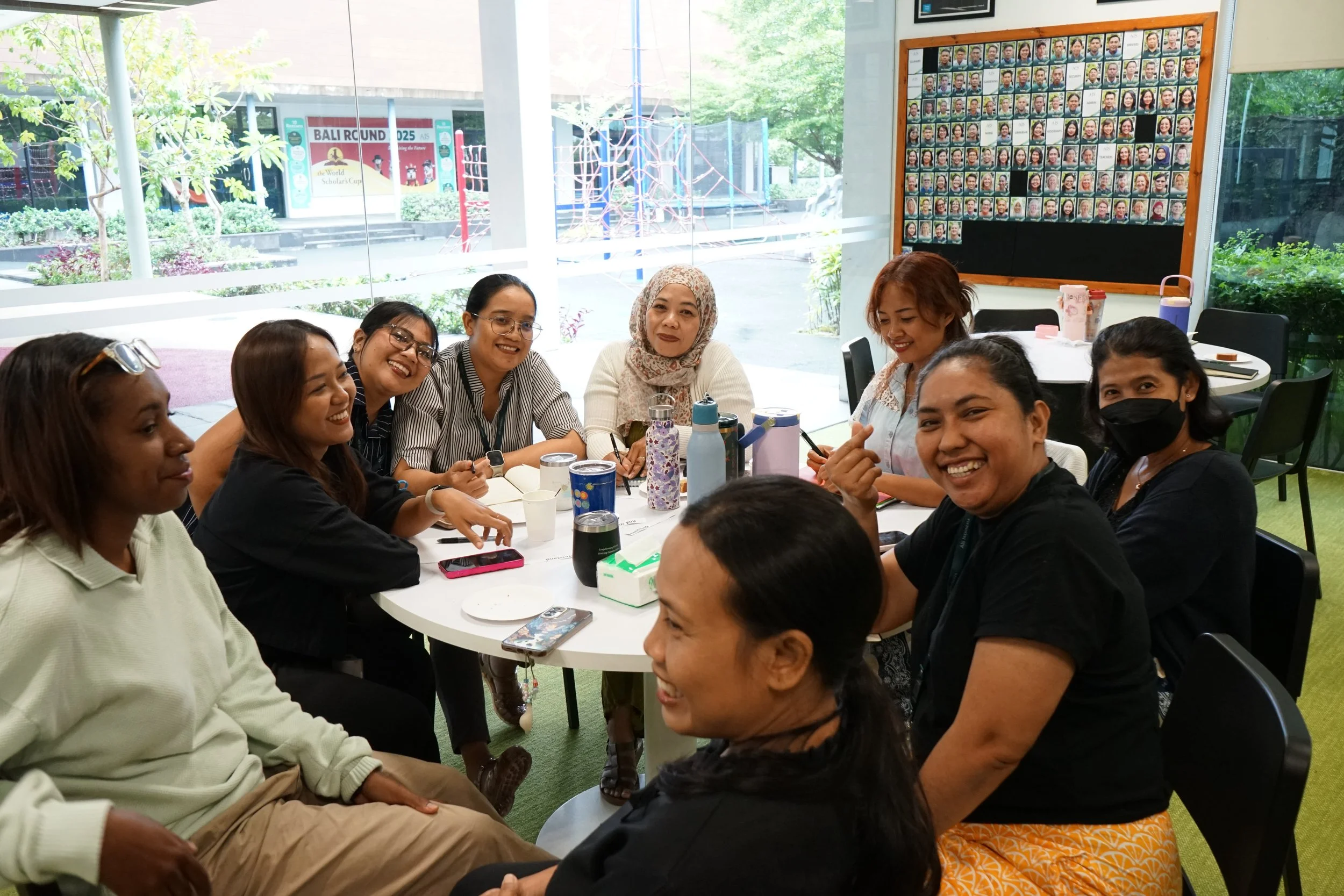
We provide practical, high-impact staff development and training for schools, early learning centres, and therapy teams. Our sessions equip educators and support staff with the knowledge, confidence, and tools to better support children’s communication needs in everyday settings. Training addresses real-world challenges, such as supporting late talkers, navigating bilingual development, and managing classroom communication demands—so teams feel capable, aligned, and supported. Investing in your team builds consistency, reduces uncertainty, and strengthens outcomes for children and families.
Explore the range of topics below designed to benefit your school team, or customise your own training to meet your staff’s specific needs.
-
This training provides an overview of how speech and language typically develop across childhood, including key developmental milestones educators should expect to see. Participants learn how to recognise early warning signs and red flags that may indicate a child is experiencing communication difficulties in the classroom. The session also focuses on practical, classroom-based strategies that educators can use to support communication, participation, and learning for all students.
-
This session focuses on early language development in young children, including the differences between typical and delayed language development. Educators gain a clearer understanding of late talkers and children with autism spectrum differences, and how communication may present differently in early years settings. Practical strategies are shared to encourage pre-verbal communication, play skills, and early language development within everyday routines.
-
This training explores what speech sound disorders are and how they may present in educational settings. Educators learn to recognise the difference between speech delay and speech disorder, including indicators for when further support or referral may be helpful. The session includes practical classroom strategies, as well as more targeted support approaches, to assist children with unclear speech, lisps, and other speech sound differences.
-
This session provides an overview of reading and spelling difficulties, including dyslexia, and how these challenges can impact learning and classroom participation. Educators learn to identify early warning signs and better understand how language skills underpin literacy development. Evidence-informed strategies are shared to support reading and spelling within the classroom and across the school environment.
-
This training supports educators to better understand attention, regulation, and behaviour from a developmental perspective. Topics include self-regulation, emotional regulation supports such as the Zones of Regulation framework, sensory profiles, and executive functioning skills. Educators are provided with practical, classroom-based strategies to support engagement, regulation, and positive learning behaviours.
-
This session introduces Developmental Language Disorder (DLD) and how it may present in the classroom. Educators gain insight into how language difficulties can impact learning, behaviour, and social interactions across different age groups. The training focuses on practical strategies to support students with language difficulties across a range of year levels and learning contexts.
-
This session provides an introduction to Augmentative and Alternative Communication (AAC), including who AAC is for and how it can support communication access. Educators learn how to use visual supports and communication systems within the classroom to support participation. The training also focuses on practical ways to support minimally verbal students to communicate, engage, and learn alongside their peers.
Get in touch to discuss a tailored training package for your team or to book a consultation.